
A year of GovTech AI
Birtist upphaflega á vef Interoperable Europe hjá Evrópusambandinu. Greinin er á ensku.
A year into developing an AI solution for public procurement with Financial Management Authority (Iceland) – FMA , Datalab (Iceland), MITA (Malta), and GovMind (Germany), funded through the EU's GovTech4All programme, we reflect on what we have learned about designing AI for expert work.
Early 2025 DataLab sat down with FMA and MITA, the organisations responsible for public procurements in Iceland and Malta, to lay down plans to develop an AI solution for generating tender documents. The idea was clear: a tender specialist would describe what they needed, and AI would generate tender documents based on previous tenders. Sounds simple enough.
Within the first weeks of working with procurement specialists, we realised something that has shaped every design decision since. Creating a good tender requires two distinct kinds of expertise. There is the procurement specialist who knows how tenders should be structured, what regulations apply, what tends to go wrong, and which past tenders are worth learning from. And there is the domain specialist who actually understands what the organisation needs to buy. AI cannot substitute for either kind of knowledge. But it can support the collaboration between them, if the workflow is designed right.
The question we have been trying to answer since then is: how do you design the best possible collaboration between these two kinds of expertise and AI?
From generation to collaboration
Instead of producing a tender from a short description, the system we are building supports both kinds of specialists through a structured process, drawing on historical tender documents and their input along the way. The procurement specialist shapes the structure and ensures the right questions get asked. The domain specialist contributes what only they know about the actual need. AI sits in the middle, surfacing relevant prior work and helping each side articulate their part. The detailed design is still evolving as we learn from real use, but the underlying principle is clear.
Tender writing requires precision, experience, and understanding of the regulatory landscape. It is something AI cannot do alone, and frankly should not. With this approach, we are seeing how AI can become a valuable support tool, helping specialists work more effectively while they remain in control and actively shape the scripts and workflows that guide the AI solution. We can see this becoming a real tool for us. – Guðrún Lilja Sigurðardóttir, Project Lead, FMA
Testing in practice
After the third sprint, specialists at both FMA and MITA tested the system. One piece of feedback particularly stood out: "it does not feel like Microsoft Copilot anymore." That is exactly what we were aiming for, a tool that knows the work.
Designing AI for expert work
The broader lesson, and the one that has reshaped how we think about AI products more generally, is that AI for expert work is fundamentally different from AI for general tasks. General AI succeeds when it can handle a wide range of inputs without much context. Expert AI succeeds when it deeply understands a narrow domain (its workflows, its language, its constraints) and serves the specialists who live in that domain every day. In the case of tender writing, that domain has two kinds of experts who need to work together, which makes the design problem even more specific.
This is also where we think the answer lies for any small AI company building in a world where Microsoft and others are racing to put AI into every product. We cannot out-build a general assistant. But a general assistant cannot replicate a specialist workflow that has been designed alongside the people who do that work. The depth of the workflow is the moat.
The pace of underlying technology makes this both easier and harder. The language models available today are dramatically more capable than those available a year ago: better reasoning, deeper context. AI-assisted development has also made it possible to design and iterate on user interfaces faster than before, which lets us be more ambitious about the product. What general platforms cannot replicate, no matter how good their models get, is a system shaped by the people who actually do the work.
Two administrations, one solution
What makes this collaboration interesting is that we are developing something that has to work in two quite different administrative environments. The testing on the Malta side has given us valuable signals about what needs to be flexible in the design and what is genuinely shared. These are exactly the conditions GovTech4All exists for. – Sarah Wilson, Project Lead, MITA
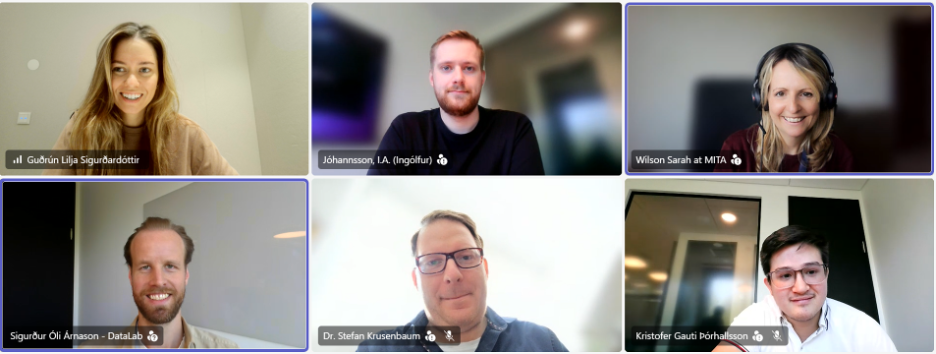
Working across two administrations has revealed something we did not fully appreciate at the start. The regulations themselves are broadly comparable across European public procurement. The real differences sit in the workflows, the data structures, and the templates each administration uses. That has shaped how we think about flexibility. The underlying logic of how procurement and domain expertise meet, mediated by AI, generalises across borders. The plumbing has to adapt.
What we have learned
We started out trying to have the AI write the tender. We discovered quickly that this was the wrong frame. A good tender draws on two kinds of expertise: knowing how tenders should be put together, and knowing what the organisation actually needs to buy. Both live with people. The question we have been trying to answer ever since is how to design the collaboration between these two kinds of knowledge and AI as well as possible. – Sigurður Óli Árnason, Project Lead, DataLab
The project's fifth and final sprint begins later this year. By then we will have a deployed system at FMA, a tested partner solution at MITA, and a clearer sense of what good AI design for expert work looks like in practice.
The best AI tools, we have come to believe, are the ones that let experts do their best work together.
Ef þú vilt spjalla um þetta, sendu mér línu á sigurdur@sigurduroli.com.